
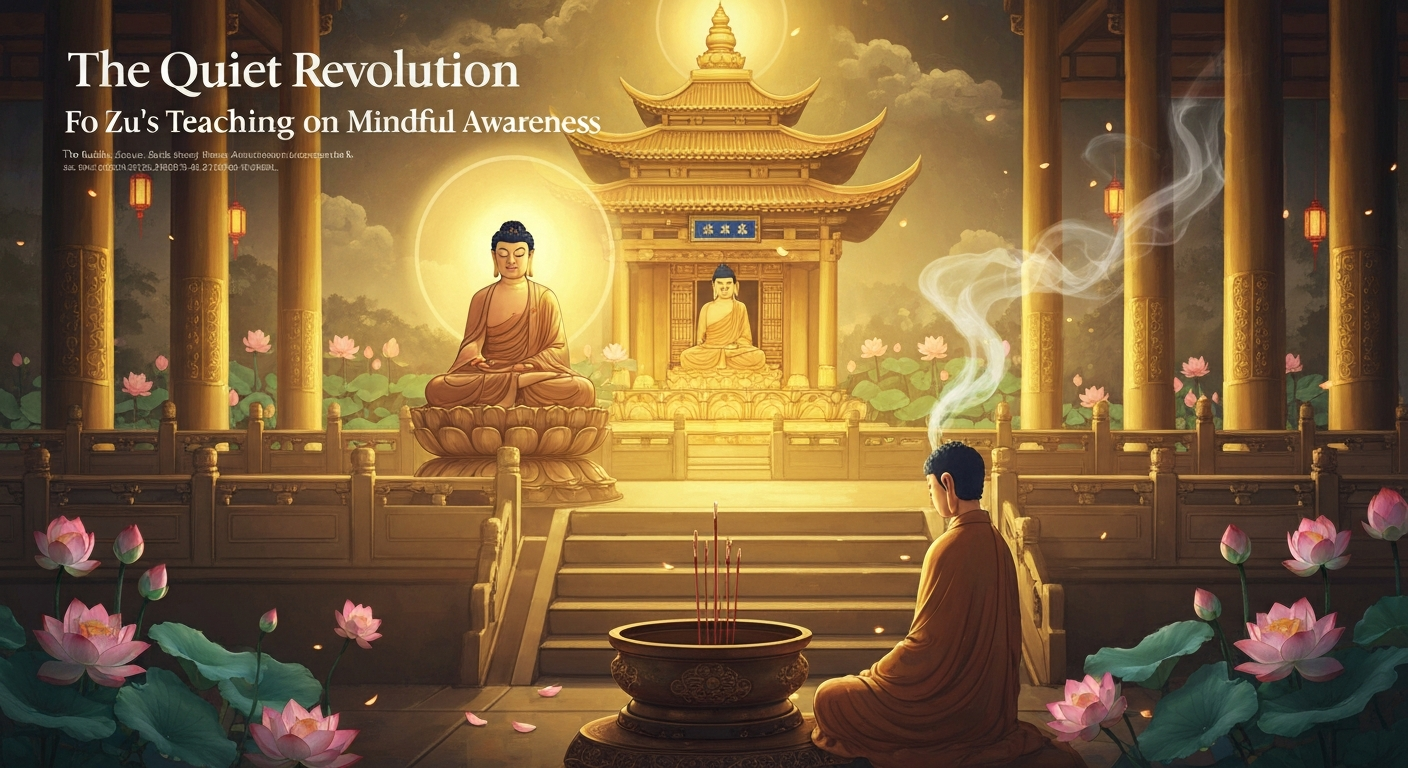
"The awakened one does not flee from the world. He meets it, completely, in this very breath."
Introduction
The Buddha — 佛祖, Shakyamuni, the Awakened One — did not offer his followers a retreat from life. He offered them something far more radical: the practice of being fully present within it. This teaching, 正念 — zhèng niàn, right mindfulness — is among the most ancient and the most urgently needed wisdom in our world today.
This essay reflects on mindful awareness as a daily virtue: not as a meditation technique reserved for quiet rooms, but as a way of living that transforms every ordinary moment into an opportunity for awakening.
What Mindfulness Is — and Is Not
In modern usage, "mindfulness" has sometimes been reduced to a stress-management tool — a method for relaxation, productivity, or self-improvement. While these benefits are real, the Buddha's teaching of 正念 is considerably deeper.
Right mindfulness, as the Buddha taught it, is the practice of seeing things as they truly are — without the distortions of desire, aversion, or delusion. It is the capacity to observe our own minds: to notice a thought arising without immediately being swept away by it, to feel an emotion without being enslaved by it, to encounter the world as it is rather than as our fears and cravings tell us it must be.
This is not a passive practice. It requires sustained, gentle attention — a willingness to return again and again to what is actually happening, rather than to the story we are telling ourselves about what is happening.
The Practice in Everyday Life
The Buddha's genius was to show that mindfulness does not require a monastery. It can be practised in the kitchen, the workplace, the market, the family home.
When we eat, are we tasting what we eat, or are we elsewhere in thought? When someone speaks to us, are we truly listening, or are we preparing our reply? When we are angry, do we act from the anger, or do we first notice it — name it, feel its texture, understand its source?
These are the questions of the mindful life. They require nothing more than a sincere willingness to pay attention — to this breath, this moment, this person before us. And yet that willingness, sustained over time, changes everything. It changes how we relate to ourselves, how we treat others, and how we move through difficulty.
The Radical Compassion of Presence
There is something quietly revolutionary about being fully present with another person. In a world of distraction, true attention is one of the rarest gifts we can offer. When we give someone our complete, undivided presence — not our advice, not our judgement, not our preoccupation with what comes next — we are offering them something the Buddha understood as deeply sacred: the recognition that they are real, they matter, and they are seen.
This is mindfulness as compassion. This is the practice that Fo Zu embodied beneath the Bodhi tree — and invites us to practise at our own kitchen table.
Reflection / Lesson
The greatest distance in the world is not between continents, but between the mind and the present moment. Most of our suffering arises not from what is actually happening, but from our thoughts about what happened, or our fears about what might happen.
Mindfulness does not eliminate difficulty. It changes our relationship to it. When we are present, even painful moments become workable. Even grief can be held. Even uncertainty becomes bearable, because we are meeting it as it is — not fighting a shadow on the wall.
This is the quiet revolution that Fo Zu offers: not a better future, but a more fully inhabited now.
Closing Prayer / Dedication
May the teaching of the Awakened One light the path of all who seek presence over distraction, clarity over confusion, and peace over the restless turning of the unguarded mind. May we find, in this very breath, the beginning of awakening.
南无释迦牟尼佛 🙏
宁静的革命——佛祖关于正念觉知的教化
"觉者不是逃离世界,而是在这一呼一吸之间,与世界完全相遇。"
引言
佛祖——释迦牟尼,那位觉悟者——并没有给追随者一条逃离生命的路。他给予的,是更为彻底的东西:在生命之中完全临在的修行。这一教化——正念——是佛陀最古老、也在今日最迫切需要的智慧之一。
这篇文章探讨觉知正念作为一种日常德行的意义:不是留给安静房间的冥想技法,而是一种将每一个平凡时刻转化为觉醒契机的生活方式。
正念是什么——又不是什么
在现代语境中,"正念"有时被简化为压力管理工具——一种放松、提升效率或自我改善的方法。这些益处确实存在,但佛陀所教导的正念,远不止于此。
佛陀所教的正念,是如实观察事物的修行——不受贪求、嗔恚或迷惑的扭曲。它是观察自心的能力:觉察一个念头升起,却不立即被它卷走;感受一种情绪,却不被它奴役;以事物本然的样子与之相遇,而非让恐惧与渴望替我们描绘它必须是什么样子。
这不是被动的修行。它需要持续而温柔的专注——一种一次又一次回到"当下真正发生的事"的意愿,而非沉溺于我们关于"正在发生什么"所编织的故事。
日常生活中的修行
佛陀的智慧在于:他证明了正念不需要寺院。它可以在厨房、工作场所、市集、家庭中修习。
当我们进食时,我们是在品尝食物,还是神游天外? 当有人与我们说话时,我们是真正在聆听,还是在构思自己的回答? 当愤怒升起时,我们是从愤怒中行动,还是先注意到它——将它命名,感受它的质地,理解它的根源?
这些都是正念生活的问题。它们不需要其他任何东西,只需要一份真诚的意愿——去关注当下的呼吸、当下的时刻、眼前的这个人。然而,这份意愿持续保持,日积月累,便能改变一切。它改变我们与自己的关系,改变我们对待他人的方式,改变我们穿越困境的姿态。
临在的彻底慈悲
完全临在于另一个人面前,有一种悄然的革命性。在这个充满分散注意力的世界里,真正的专注是我们能给予的最稀有礼物之一。当我们给予某人我们完整、专注的临在——不是建议,不是评判,不是对接下来要发生什么的心不在焉——我们给予的,正是佛陀所理解的神圣之事:承认他们是真实的,他们是重要的,他们被看见了。
这就是正念作为慈悲的面貌。这正是佛祖在菩提树下所体现、并邀请我们在自家饭桌旁修习的修行。
感悟与启示
世界上最远的距离,不是大陆之间,而是心灵与当下时刻之间。我们大多数的苦,并非来自真正发生的事,而是来自关于已经发生之事的思虑,或对可能发生之事的恐惧。
正念不能消除困难。它改变的是我们与困难的关系。当我们临在时,即便痛苦的时刻也变得可以应对,即便悲恸也能被承载,即便不确定也变得可以忍受——因为我们正在以它本然的样子与之相遇,而非与墙上的影子搏斗。
这就是佛祖所给予的宁静革命:不是一个更好的未来,而是一个被更充分活出的当下。
结语与回向
愿觉悟者的教化,为所有寻求临在而非分散、寻求清明而非迷惑、寻求平静而非躁动不安之心的人照亮道路。愿我们在这一呼一吸之间,找到觉醒的起点。
南无释迦牟尼佛 🙏
Explore Other Deities · 了解其他神明
To know more about other deities and decipher their oracle lots, visit: