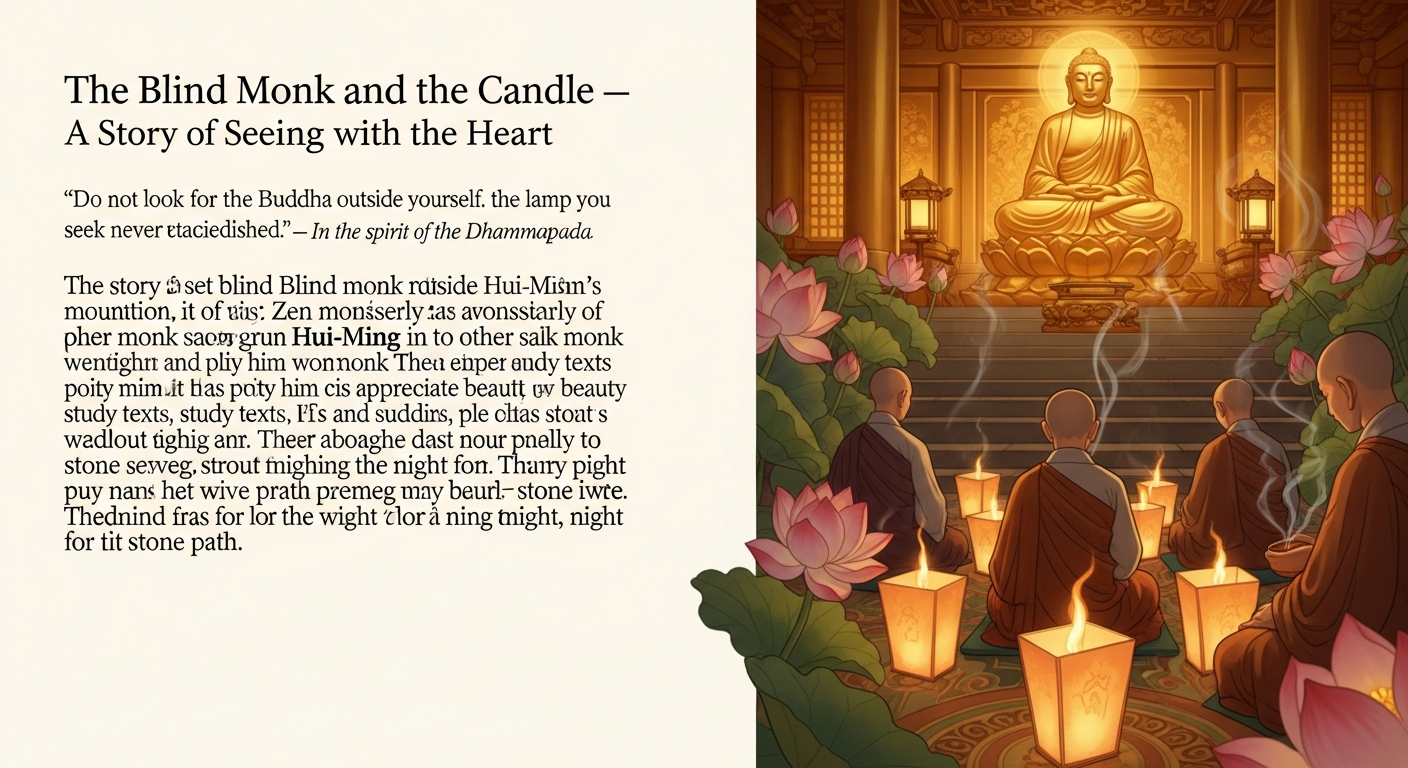
The Blind Monk and the Candle — A Story of Seeing with the Heart
“Do not look for the Buddha outside yourself. The lamp you seek was never extinguished.”
“— In the spirit of the Dhammapada”
Introduction
Among the many teachings passed down from 佛祖 — the Awakened One — some of the most luminous come not in elaborate discourses but in small, quiet moments. This is a story told in the Zen tradition, of a blind monk who understood something that those with sight had missed entirely.
The Story
In a mountain monastery, there lived a monk named Hui-Ming who had been blind from birth. The other monks — young, quick-eyed, and proud of their learning — sometimes pitied him. How could he meditate on the beauty of the lotus? How could he study the sacred texts without eyes to read them?
One evening, as the monks prepared for night prayer, each lit a paper lantern to carry along the stone path to the hall. Hui-Ming carried his lantern too.
A young monk named Dao-Qing, curious and a little unkind, said to him: "Brother Hui-Ming, why do you carry a lantern? You are blind. The light is of no use to you."
Hui-Ming paused on the path. He turned toward the young monk — not quite toward his face, but close enough to make Dao-Qing feel oddly seen.
"The lantern," said Hui-Ming, "is not for me to see by. It is so that you do not walk into me in the dark."
There was a long silence. The other monks stood still on the path.
The abbot, who had been walking behind them all, stopped and bowed his head slightly. He said nothing. But Dao-Qing reported years later that in that moment, he understood what the masters had been trying to teach him all his years in the monastery: that wisdom is not for the one who holds it. It exists to light the way for others.
Hui-Ming continued walking calmly, his lantern steady, its flame unhurried.
Reflection
The Buddha's teaching of “compassion” — compassion — is not a feeling turned inward. It is a light held outward. The enlightened mind does not hoard its warmth. It offers it freely, without needing to be seen doing so, without requiring that others acknowledge the gift.
Hui-Ming did not carry his lantern to prove anything. He carried it because the darkness around him was real, even if it was not his darkness. This is the heart of the Dharma: the awareness that we are not separate from one another's struggles.
Closing Prayer / Dedication
May the light of the Awakened One illuminate our path, and may we — even in our own darkness — remember to carry a lantern for those walking beside us.
南无本师释迦牟尼佛 🙏
盲僧与烛光——以心观见的故事
“莫向外求佛,那盏灯从未熄灭。”
“——取意于《法句经》”
引言
佛祖——觉者所传之教,有许多最为光明的开示,并非出自宏大的法会,而来自微小、宁静的时刻。这是禅宗传统中流传的一个故事,讲述一位生来双目失明的僧侣,如何看见了那些明眼人完全错过的真相。
故事
山中一座寺院里,住着一位名叫慧明的僧侣,他自幼双目失明。其他的僧侣——年轻、眼明,以学识为荣——有时候会怜悯他。他无法观想莲花之美,无法用眼睛阅读经典,如何修行?
一日傍晚,僧众准备晚课,每人点燃一盏纸灯笼,沿着石径走向大殿。慧明也提着灯笼同行。
年轻的僧侣道清,好奇而言语间带着一丝刻薄,问道:"慧明师兄,你为何要提灯?你是盲人,灯光对你毫无用处。"
慧明在石径上停下脚步,转向那位年轻僧侣——不全然朝向他的脸,却足以让道清感到一种奇异的被看见。
"这灯笼,"慧明说,"不是给我照路的。是为了让你在黑暗中,不要走进我的身上。"
四周沉默下来,众僧俱立于石径之上,一动不动。
住持一直走在众人身后,此刻停住脚步,微微颔首,没有开口。但道清多年后述说,就在那一刻,他终于明白了历年来师父们一直想要教导他的事:智慧不是为持有它的人而存在。它存在,是为了照亮他人的路。
慧明平静地继续前行,灯笼稳稳在手,烛焰悠然不急。
感悟与启示
佛祖所教的"慈悲",不是向内收敛的情感,而是向外举起的光。觉悟之心不囤积温暖,而是自由地给予——无需被看见,不求被感谢。
慧明提灯,不为证明什么。他提灯,是因为他身边的黑暗是真实的,即便那黑暗并非属于他。这是法的核心:我们与他人的苦难,并非彼此隔绝。
结语与回向
愿觉者的光明照亮我们的路,愿我们——即便身处黑暗之中——也记得为身旁同行的人,提起那一盏灯。
南无本师释迦牟尼佛 🙏
Explore Other Deities · 了解其他神明
To know more about other deities and decipher their oracle lots, visit: