
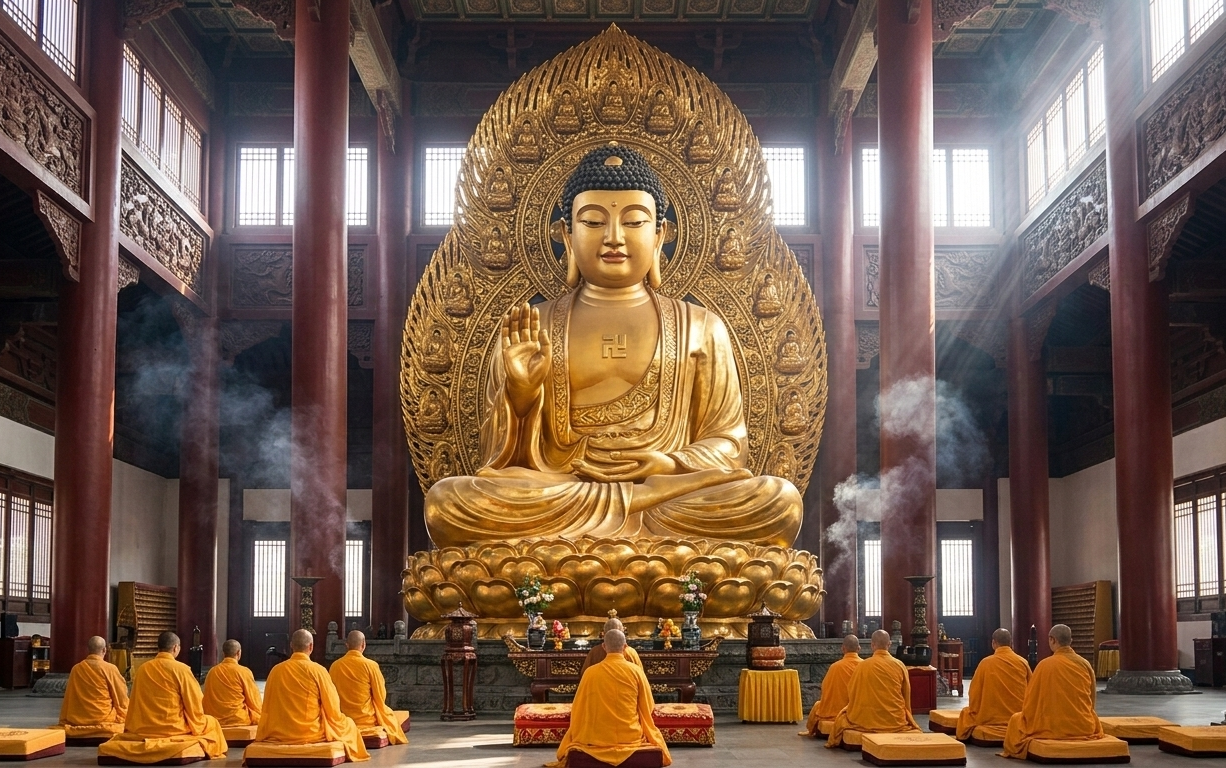
Fo Zu (佛祖), literally “Buddha Ancestor” or “Founding Buddha,” is the title given in Chinese popular religion to Shakyamuni Buddha — Siddhartha Gautama — the historical founder of Buddhism. Born around 563 BCE in Lumbini (present-day Nepal), Siddhartha was a prince of the Shakya clan, living in luxury and shielded by his father from all suffering in the world. Yet destiny had other plans.
As a young man, Siddhartha ventured outside the palace walls on four fateful occasions. He saw an old man, bent and feeble; a sick man, wracked with pain; a corpse being carried to cremation; and finally, a wandering ascetic monk — serene, still, and at peace. These encounters — known as the Four Sights — shattered the illusion that beauty and comfort could last. Siddhartha understood that old age, sickness, and death awaited every living being.
At the age of twenty-nine, he renounced his throne, his wealth, his beloved wife Yasodhara, and his infant son Rahula. He cut off his hair, exchanged his royal robes for simple cloth, and set out alone into the forest to seek the answer to suffering. For six years, he practised extreme asceticism — fasting, enduring heat and cold, reducing his body to near skeletal thinness. Yet enlightenment did not come.
He realized that self-mortification was no closer to truth than self-indulgence, and he chose what he called the “Middle Way” — a path between extremes. He accepted a bowl of rice milk from a young woman named Sujata, recovering his strength, and then sat beneath a great fig tree — the Bodhi Tree — in Bodh Gaya, India. He resolved not to rise until he had achieved enlightenment.
Through the night, the demon Mara attacked him with armies of illusion, temptation, and fear. But Siddhartha remained unmoved, calm and deeply concentrated. As the morning star appeared at dawn, he achieved full enlightenment — understanding the true nature of reality, the cause of suffering, the path to its cessation, and the liberation that lies beyond all conditioned existence. In that moment, Siddhartha Gautama became the Buddha — the Awakened One.
For the next forty-five years, the Buddha walked the plains of northern India, teaching what he had realized. His first teaching, delivered at the Deer Park in Sarnath, set forth the Four Noble Truths and the Eightfold Path — the foundation of all Buddhist practice. He gathered disciples from all walks of life — kings and outcasts, men and women, scholars and street people.
At the age of eighty, the Buddha entered parinirvana — his final liberation from the cycle of birth and death — at Kushinagar. His last words to his disciples were said to be: “All conditioned things are impermanent. Work out your own salvation with diligence.”
The tradition of Fozu oracle lots (佛祖签) allows devotees to receive the Buddha's wisdom for their life's questions through sincere prayer and lot-drawing. To invoke the Buddha is not to seek magic, but to align oneself with the deepest truths of existence. His teaching is, ultimately, a lamp in the darkness. Namo Shakyamuni Buddha (南無本師釋迦牟尼佛).
佛祖释迦牟尼:觉悟者的慈悲之路
佛祖,即释迦牟尼佛(Śākyamuni Buddha),是佛教的创立者,也是无数华人信众心中最崇高的精神导师。他原名悉达多·乔达摩(Siddhartha Gautama),约公元前563年出生于迦毗罗卫国(今尼泊尔)的王室之家,自幼受尽皇室荣华,锦衣玉食,无忧无虑。
然而,一次次宫外的行游,彻底改变了这位王子的人生轨迹。他先后目睹了一位佝偻老人,一位痛苦病者,一具被抬行的尸身,以及一位沉静安然的云游僧侣。这「四相」的冲击,让他深切领悟:世间没有任何宫殿或财富,能让人逃脱老、病、死的命运。
二十九岁那年,悉达多悄然离开王宫,告别了深爱他的妻子耶输陀罗与刚出生的儿子罗睺罗,脱下王服,剃去头发,以简朴的苦行者身份踏上了求道之路。此后六年,他以极端的方式磨砺肉身,身体消瘦至极。然而,苦修并未带来解脱。
他意识到,过度的苦行与过度的享乐同样是两个极端,都不能通达真理。于是,他选择了「中道」——接受一位名叫苏迦塔的少女供养的乳糜,恢复体力,独自前往菩提迦耶,在一棵菩提树下盘腿端坐,发誓:不证悟,不起身。
当夜,魔罗率众来袭,以欲望、恐惧、疑惑等种种幻象试图动摇悉达多的心念。然而,他岿然不动,深入禅定。黎明时分,晨星升起,悉达多终于彻底觉悟,洞见了生命的本质、苦难的根源与解脱的道路。从此,他被称为「佛陀」——意为「觉悟者」,汉语中称为「佛祖」。
悟道后,佛陀以无尽的慈悲心,走入恒河平原,为众生说法。他的第一次讲法(初转法轮),在鹿野苑向五位苦行者传授了「四谛」与「八正道」,奠定了佛法的根基。此后四十五年,他云游四方,开示众生,无论贵族贫民,皆在他的教化之列。
八十岁时,他在拘尸那迦安然入灭,临终时告诉弟子们:「诸行无常,当精进求解脱。」
在中国佛教文化中,佛祖是最高尊崇的对象。「佛祖签」是华人佛教信仰中的重要传统,信众在佛祖像前虔诚礼拜,摇动签筒,取出签诗,借助佛陀的智慧,在迷茫中重新找到方向。南无本师释迦牟尼佛。
Explore Other Deities · 了解其他神明
To know more about other deities and decipher their oracle lots, visit: